Geolocation Tool SPOT: Reworked & Out of Beta
,SPOT has officially graduated from beta. After spotting a couple of blind spots (pun intended), we're happy to announce our AI-driven web service now helps you verify geolocations more accurately than ever.
In case you're not yet familiar with SPOT yet: It’s a free tool that helps investigators, journalists, and open-source researchers verify locations using natural language prompts. Just describe what you’re looking for – say, a place shown in a photo or video - and SPOT searches OpenStreetMap (OSM) for matching locations.
For example, you could ask:
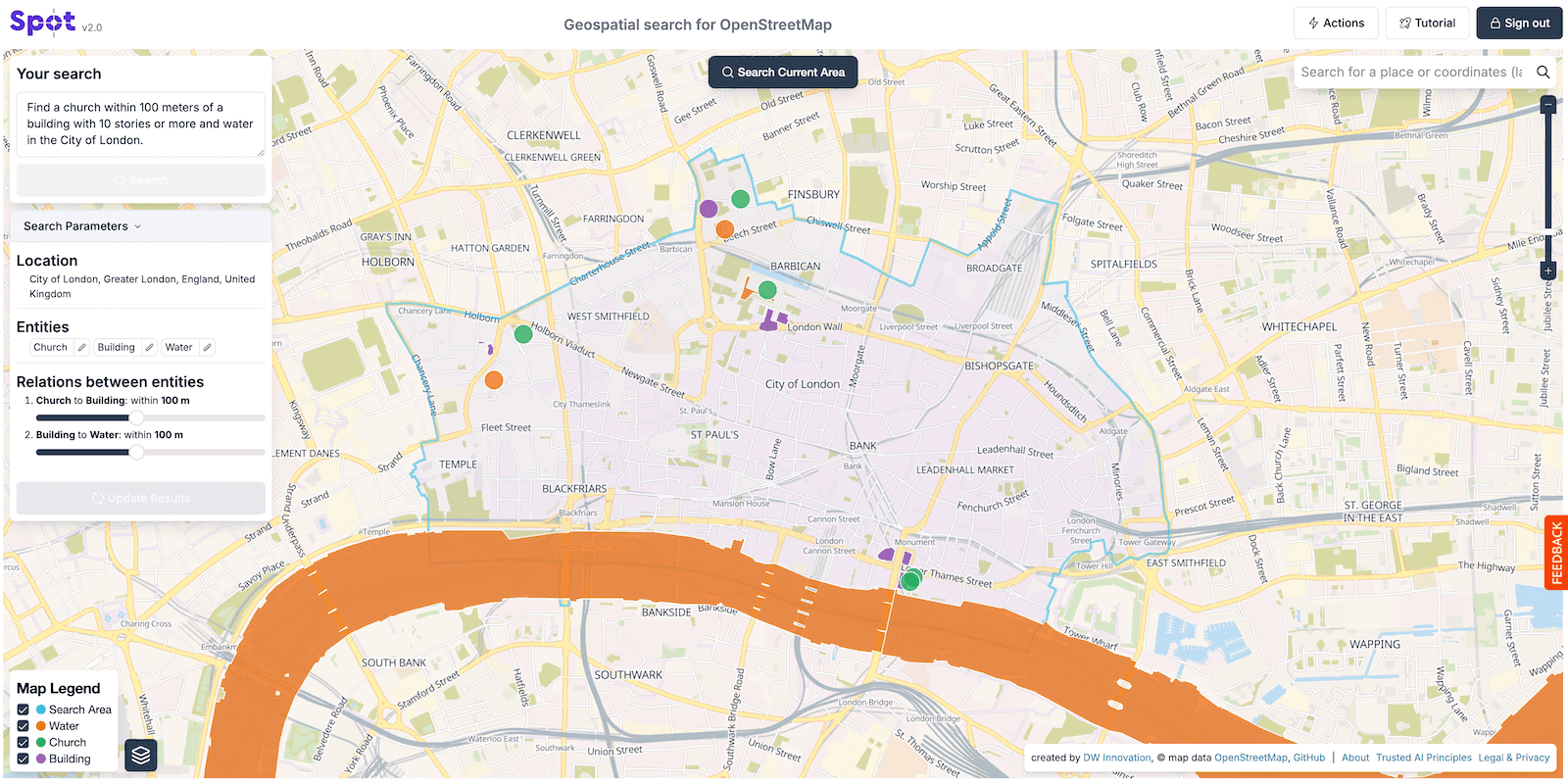
"Find a church within 100 meters of a building with 10 stories or more and water in the City of London."
SPOT then searches OSM data and displays all matching locations on an interactive map:
A Major Upgrade Behind the Scenes
After two years of training and fine-tuning our own AI models, we've significantly upgraded how SPOT works.
Our benchmarking system revealed something surprising: a larger open-weights model without custom training consistently outperformed our smaller fine-tuned model. Thanks to recent advances in AI and the availability of new models through the DW LLM Hub, we were able to make the switch.
As a result, SPOT is now more accurate, more robust, and easier to maintain.
The change also reduces the time and resources previously needed for generating training data, maintaining benchmark datasets, retraining models, and hosting custom infrastructure.
Building datasets, training models, and evaluating performance gave us deep insight into how AI systems behave in real-world applications. That experience helped us build a stronger, more sustainable foundation for SPOT.
SPOT 2.0 Improvements
The new version of SPOT brings several important improvements:
- better overall performance and reliability
- faster implementation of fixes and enhancements through prompt engineering
- easier migration to newer and more capable AI models
- expanded coverage of OSM tags
- improved search engine
- better recognition of entities with specific attributes (e.g. "Italian restaurant" or "vegan café")
- improved tutorials
New Feature: Tag Bundle Editor
SPOT now also includes a Tag Bundle Editor, a feature that allows you to explore how semantically related OSM tags are grouped together.
For example, you can see how tags associated with "airport" are separated from tags associated with "military airport."
The Tag Bundle Editor also lets you suggest changes when tag groupings don't behave as expected, helping us continuously improve SPOT's search results.
Free and Open Source
SPOT is available free of charge at https://findthatspot.io.
The entire project is open source and hosted on GitHub.
We welcome feedback, bug reports, feature suggestions, and contributions from the community. Get in touch via hey[at]findthatspot.io – or connect with us on GitHub. We'd love to hear from you.
